

A Story We Must Remember
To honour is to remember and to share the stories of those who came before us. ANZAC Day pays tribute to our heroes through remembrance and reflection, not merely through ceremonial marches. Toowong Cemetery in Brisbane has become the final resting place of many Russian soldiers — men whose stories deserve to be preserved and passed on to future generations.
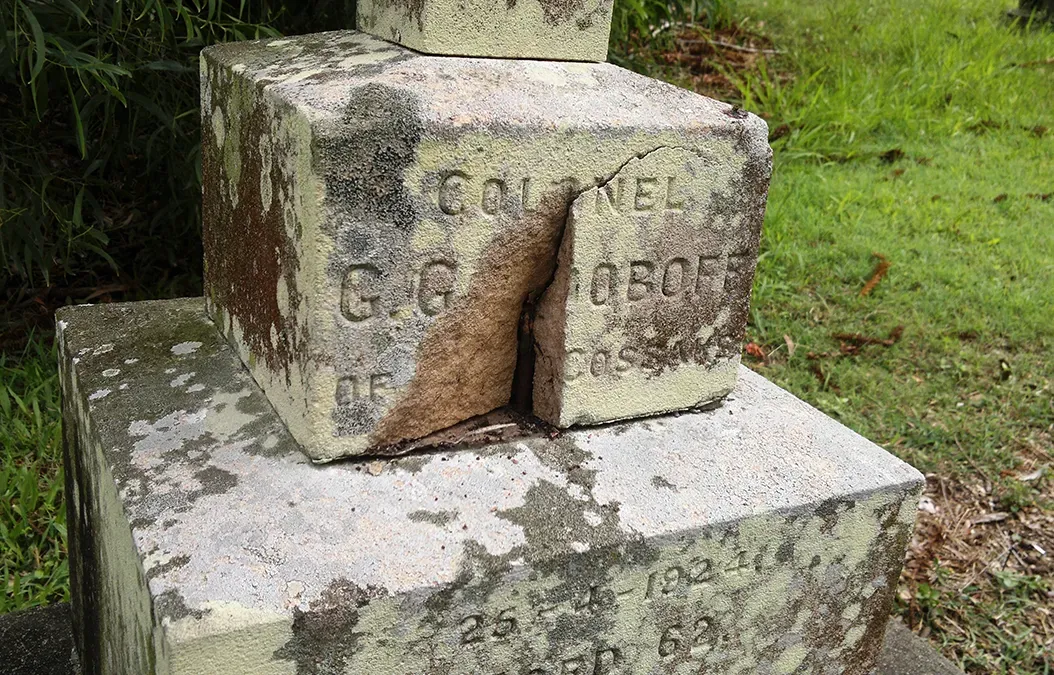
The Russian Orthodox section of Toowong Cemetery lies near the top of a hill. Yet a little further down, beneath the shade of an Australian eucalyptus tree, stands a solitary grave marked by an Orthodox cross. Its recently restored sandstone memorial dates back to a time when there was not yet a designated Russian section of the cemetery.
Within our community, we often say that those buried at Toowong are not simply names on gravestones. Behind them lie extraordinary lives shaped by wars, revolutions, and journeys across continents. One such story belongs to Colonel Georgy Yeremeyevich Golubov, a Ural Cossack and an officer of the old Russian military tradition. Despite extraordinary hardships, he managed to bring his family to the shores of Australia.
“Georgy Yeremeyevich Golubov was born on 6 April 1867 into the family of a priest serving the Ural Cossack Host. He graduated from the Orenburg Military Preparatory School. In 1883, he entered the service of the Ural Cossack Host and, in the same year, enrolled at the Orenburg Military Cadet School. He graduated two years later with the rank of junior Cossack officer and was promoted to the rank of khorunzhy the following year.
In 1890, he was promoted to sotnik. He served as ataman of the Goryachinskaya, Yamakhalinskaya, and Guryevskaya Cossack settlements. In 1909, he attained the rank of esaul and was awarded the Order of St Stanislaus, Third Class.
He served in the First World War and was promoted to colonel in 1917. During the Russian Civil War, he commanded a Separate Composite Infantry Division and headed the Records Department of the Ural Army Headquarters.
In 1920, he took part in the legendary retreat to Fort Alexandrovsky as a member of General Tolstov's detachment, sharing the fate of the Ural Cossacks who followed their commander into Persia and later stayed together in the Russian camp at Basra.
In 1923, General Tolstov's detachment, numbering 66 people, arrived in Brisbane. Among those who stepped from the steamship onto Australian soil was Georgy Yeremeyevich Golubov.
Sadly, fate was not kind to him. He died soon afterwards, on 24 April 1924.
Unfortunately, we have not yet been able to establish what became of his family. Georgy Yeremeyevich was married to Maria Ivanovna Skvorkina (born 1888). They had two sons, Boris (born 1894) and Vladimir (born 1898), and two daughters, Lydia (born 1900) and Natalia (born 1903).
Colonel Golubov's grave is one of the earliest Russian burial sites in this cemetery.” — V. Smolina
Why Am I Telling This Story?
Because it is an inseparable part of our shared history and collective memory. Men like Colonel Golubov should not simply disappear into the silence of forgotten archives.
His journey from the Ural region to Brisbane stands as a testament to courage, duty, and devotion to those closest to him. He was among the pioneers of the Russian community in Australia.
Today, at Toowong Cemetery, Mount Gravatt Cemetery, and other burial grounds across Queensland, many of our Russian heroes rest far from their homeland. Sadly, as the years pass, many of their graves have been left without anyone to care for them.
It would be a wonderful gesture if today's Russian-Australian families could each take responsibility for even one of these nearly forgotten graves.
To visit on Radonitsa, the Orthodox day of remembrance of the departed; to tidy the resting place, light a candle, offer a prayer for the deceased, and share the joyful message of Christ's Resurrection — these are simple acts, yet they carry profound meaning.
Only then can we say with a clear conscience: “We Remember — Lest We Forget.”
May their memory live forever.
In Memory of a Son of the Urals
Duty and honour. An oath before the icons —
Not empty words, my brother, but a vow.
A Cossack rode across the scorched hillsides,
Where blood had stained the grass a crimson glow.
No more will hoofbeats ring across the Urals,
Nor stir the feathergrass beneath the sky.
Fate bore him far away to foreign shores,
Where he became part of the earth in which he lies.
Sleep, Colonel. Your companions from the battlefield,
Their final pennies gathered in their hands,
Raised a stone for you in distant exile,
Far from the freedom of your motherland.
No longer does a graceful Russian birch tree
Whisper tender words through rustling leaves.
Instead, a rough Australian eucalyptus
Recites a prayer above the place you sleep.
Upon Toowong's hill, a Cossack stood in prayer.
The wind sang softly of his people, proud and free.
He bowed before the Lord in humble reverence,
Then set forth on his final journey.
Translated from the original Russian poem. The English version is a literary adaptation intended to preserve the imagery, meaning, and spirit of the original.